
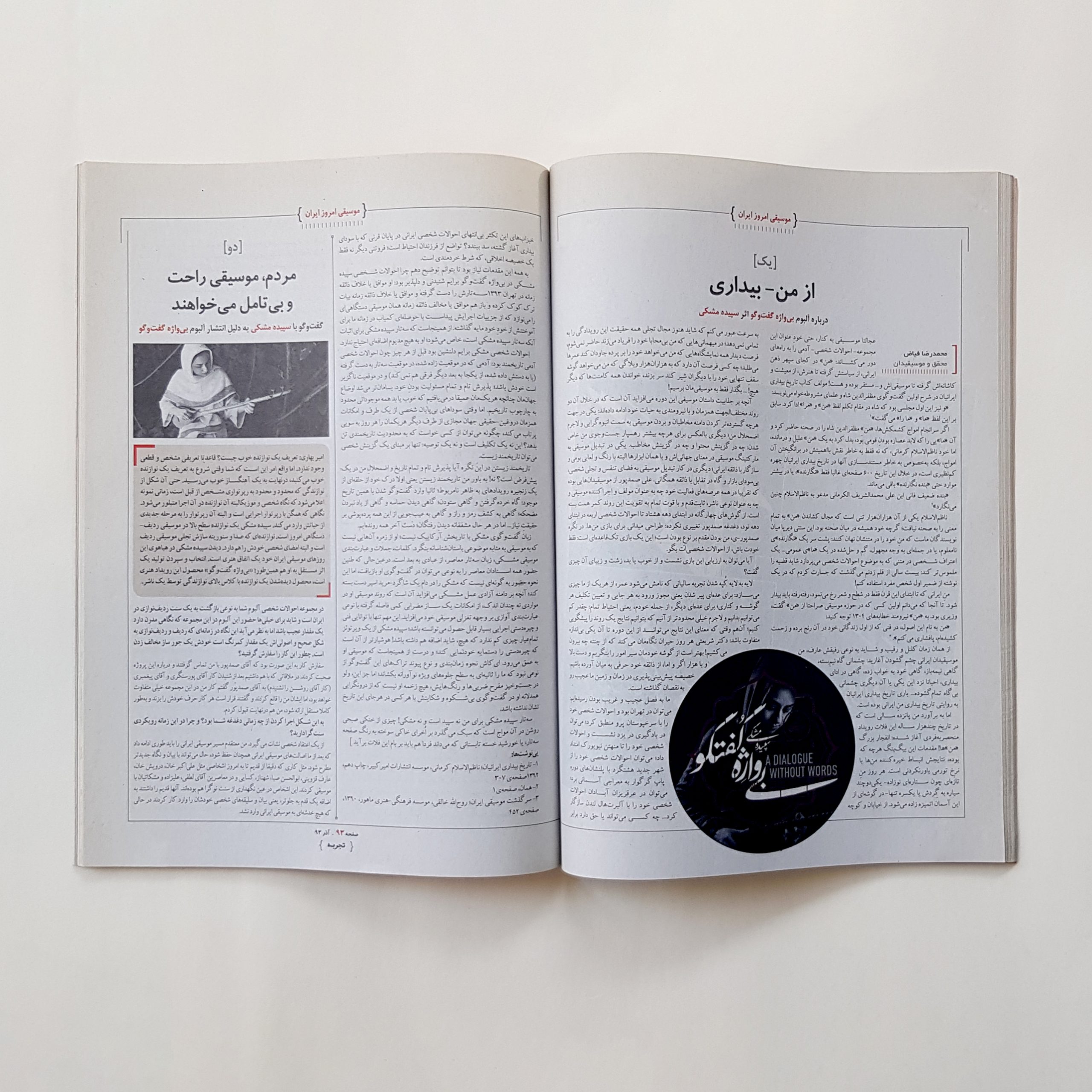
Awakening of the Self
On the album “Bi-Vājeh Goft-o-Go” (Wordless Dialogue) by Sepideh Meshki
Written by Mohammad-Reza Fayaz (researcher and musician)
For the moment, setting the music aside—even the very title of this collection, “Personal States,” sends one’s mind down distant paths. Where has the “I” been situated, and where does it stand, in the Iranian mental universe—from politics to art, from livelihood and home to music? The author of The History of the Awakening of Iranians, in describing the first conversation between Mozaffar al-Din Shah and the constitutionalist clerics, writes: “This was also the first gathering in which the Shah, while speaking, uttered the words ‘I’ and ‘me.’ Before this, he used to say ‘we’ and ‘us.’”
If, in the end, the waves of struggle brought Mozaffar al-Din Shah’s “I” onto the stage, transforming that “we”—which must have been the distilled essence of a people—into a frail and helpless “I,” still Nazem al-Islam Kermani himself, not only because of his important role in stirring up those waves but especially because of his documentation of them in The History of the Awakening of Iranians, remains a singular figure who, throughout that six-hundred-page history, mostly stays merely “the writer,” or more often even “this humble writer.”
“This weak, mortal servant, son of Ali Mohammad al-Sharif al-Kermani, known as Nazem al-Islam, thus writes.” Nazem al-Islam was one of those countless individuals who never found the opportunity to fully bring the “I” onto the stage—although he himself was always present at the heart of events. This is a long-standing tradition among our writers: to hide the self within the text—behind an anonymous “writer,” within passive constructions, or dissolved into a general “we.”
A personal confession in a text dealing with personal states may make this more tangible: it took me some twenty years of writing before I dared to use the first-person singular in an essay. The Iranian “I,” which until the beginning of this century appeared only in mystical utterances and poetry, gradually had to awaken. As far as I know, the first person in the field of music to explicitly speak in terms of “I” was Vaziri. Pay attention to the powerful “I” of his 1925 speeches:
“I insist, in the name of these principles, in an art in which I have suffered and labored from the very beginning of my life.”
From that time on, the Iranian musician’s “I” began to open its eyes—through Colonel Vaziri and his rival, and perhaps in some sense his companion, Aref: eyes sometimes half-closed, sometimes half-open, sometimes pretending to sleep, sometimes performing wakefulness; occasionally, in one or another, eyes suddenly fully open… In any case, The History of the Awakening of Iranians can also be read as the history of the awakening of the Iranian “I.”
In my estimation, however, over the past fifteen years an unprecedented event has begun in the several-thousand-year history of this plateau: the Big Bang of “I”s. Whatever the preconditions of this Big Bang may have been, its results are a dazzling expansion of selves at an unbelievable inflationary rate. Every day a new “I,” like a newborn star, is born in this atomized sky—sometimes with one or two planets orbiting it, sometimes entirely alone in a corner.
I pass quickly through streets and alleys, for perhaps they still do not fully allow the manifestation of the whole truth of this eventfulness; I do not attend parties where the “I” shouts itself without restraint; a lifetime would be required to visit all the exhibitions where the “I” seeks to eternalize itself on a screen; who has the time to visit the thousands upon thousands of blogs where the “I” wants to share a corner of its lonely ceiling with others—let alone read all the comments! … Let us, then, turn only to our music.
What adds to the fascination of the musical story of this period is that within it two opposing trends have simultaneously and forcefully continued their lives: one toward expanding the audience as much as possible and pushing music toward massification and, inevitably, the dissolution of the “I”; the other, conversely, toward an ever more determined search for a distinctive “I”—both in the selection of content and in the choice of audience. One seeks to turn music into music marketing in its global sense, using the same tools, albeit with a local coloring adapted to Iranian taste; the other works to transform music into a space for breathing and personal manifestation, without concern for the market and sometimes even in opposition to popular taste.
Ali Samedpour has been among those musicians who, in nearly all areas of his activity—whether as a composer and performer or as a kind of publisher—has steadfastly and vigorously committed himself to strengthening this latter trend. From Chahargāneh Goushehs in the early 2000s to Ahvālāt-e Shakhsi-ye Arba‘eh in the early 2010s, Samedpour’s concern has not changed: designing a field for the play of “I”s. In Samedpour’s perspective, being “I” precedes being a “type.” This is a one-rule game: just be yourself; speak of your personal states.
Can this game be evaluated, and can anything be said of its good or bad, its ugliness or beauty? Layer by layer, the becoming of years of experience—called a lifetime—shapes something from each of us. For some, growing old means a license to enter anywhere and dictate matters everywhere; for others, myself included, it means utmost caution—how little we can know, and therefore how much more limited we are than to predict the outcomes of a process, especially when the meaning of those outcomes can differ immeasurably from one period to another. Dr. Shariati leaves us astonished every day at what we pull from our bag! It is better to observe the course of events from our own corner and, with many ifs and buts, speak only of our own taste.
Predictability, in our time and place, has strangely diminished. We have reached a season of strangeness: one can be in Tehran and align one’s personal states with the Native Americans of Peru; one can sit in a wind-catcher house in Yazd and extend one’s personal states to Manhattan, New York; one can take one’s personal states from the new city of Hashtgerd, with Gregorian pop planeshan, to a celestial ascension; one can, amid the sweltering sweat of Abadan, attune one’s personal states to London’s Albert Hall… Who can—or has the right to—erect a barrier against the surging waves of this endless multiplicity of Iranian personal states at the end of a century that began with the dream of awakening?
Humility is born of caution; modesty is no longer merely a moral trait but a condition of wisdom. All these preliminaries were necessary for me to explain why Sepideh Meshki’s personal states in Bi-Vājeh Goft-o-Go were, for me, listenable and delightful. In agreement with—or in defiance of—the taste of the times in Tehran in 2014, she takes her setar in hand; in agreement with—or in defiance of—the taste of the times, she tunes it to Bayāt-e Tork; and again, in agreement with or opposition to prevailing taste, she plays the same dastgāh music—one can tell from the details of her performance—that she has learned with a rare patience in our era, investing deeply of herself.
It is from here that Sepideh Meshki’s setar becomes distinctive, proving that it is indeed her setar; she needs no additional medium. Meshki’s personal states were pleasing to me, above all, because they were the personal states of a historical being: a person born into a situation, who takes the setar in hand within a situation (or has it placed in her hands—at some point it no longer matters), and who, within that situation, is compelled to be herself—fully accepting responsibility for her own being.
Our world would be more orderly if each of us deeply understood that, whether good or bad, we are all beings confined within a historical framework. But when endless personal desires on one side and the simultaneously false-yet-real possibilities of the virtual world on the other fling each of us in a new direction every day, how can one ask anyone to submit to the limitation of historicity? This is neither a duty nor a recommendation; only on the basis of a personal choice can one live historically.
Does living historically, in this view, mean the total acceptance of history and the dissolution of the “I” into a presupposition? No. I believe living historically means, first, understanding oneself as a link in a chain of seemingly unrelated events; second, entering into dialogue with this very existing history—sometimes criticizing, sometimes praising; sometimes seeing epic, sometimes not forgetting farce; sometimes seeking to uncover mysteries, sometimes fault-finding with all this veiling of truth… but in any case, viewing those who have gone before with compassion. In the end, we are all travelers.
Meshki’s language of dialogue with her history is not archaic; she is not among those who view music as an archaeological subject. The words, sentences, and phrasing of Meshki’s music are the language of the contemporary setar, from Ebadi onward. While the resonance of the presence of all contemporary masters can, in some way, be rediscovered in her dialogue, this presence is not of a kind that traps Meshki as a bound disciple. What expands the scope of her freedom is that the course of her music, in not a few instances, moves somewhat away from the typical possibilities of a plucked instrument, adding to its lyrical character through a kind of vocal phrasing.
This achievement could only have been possible through great technical ability and masterful execution; Sepideh Meshki lacks nothing of a full-fledged virtuoso—perhaps she even has something extra. She is too perceptive to turn virtuosity into a means of self-display, and it is precisely from here that her music gains depth. If only the timing and the way the tracks of this dialogue are linked were not such as to pull us, even for a second, toward the surface of innovative special effects. Aside from this, even in the lively leaps of its rhythmic pieces and colors, there is not a single pluck that does not bear the mark of her empathetic inwardness in her unpretentious, complaint-free dialogue with anyone, anywhere in this history.
ازمن_بیداری
دربارهی آلبوم “بیواژهگفتگو” اثر سپیده مشکی
نوشتهی : محمدرضافیاض (محقق و موسیقیدان )
عجالتا موسیقی به کنار، حتی خود عنوان این مجموعه “احوالات شخصی” آدمی را به راه های دور می کشاند «من» در کجای سپهر ذهن ایرانی از سیاستش گرفته تا هنرش از معیشت و کاشانه اش گرفته تا موسیقی اش و مستقر بوده و هست! مولف کتاب تاریخ بیداری ایرانیان در شرح اولین گفت و گوی مظفر الدین شاه و علمای مشروطه خواه می نویسد: “و نیز این اول مجلسی بود که شاه در مقام تکلم لفظ «من» و «مرا» ادا کرد. سابق بر این لفظ «ما» و «ما را» می گفت” اگر سرانجام امواج کشمکشها، «من» مظفر الدین شاه را در صحنه حاضر کرد و آن “ما” یی را که لابد عصاره بودن قومی بود بدل کرد به یک «من» علیل و درمانده اما خود ناظم الاسلام کرمانی که نه فقط به خاطر نقش با اهمیتش در برانگیختن آن امواج، بلکه به خصوص به خاطر مستندسازی آنها در تاریخ بیداری ایرانیان چهره کم نظیری است در خلال این تاریخ ۶۰۰ صفحه ای غالبا فقط “نگارنده”، یا در بیشتر موارد حتی “بنده نگارنده” باقی می ماند. “بنده ضعیف فانی ابن علی محمد الشريف الكرماني مدعو به ناظم الاسلام چنین می نگارد”. ناظم الاسلام یکی از آن هزاران هزار تنی است که مجال کشاندن «من» به تمام معنی را به صحنه نیافت؛ گرچه خود همیشه در میان صحنه بود. این سنتی دیرپا میان نویسندگان ماست که من خود را در متنشان نهان کنند: پشت سر یک «نگارنده»ی نامعلوم یا در جمله ای به وجه مجهول، گم و حل شده در یک «ما»ی عمومی… یک اعتراف شخصی در متنی که به موضوع احوالات شخصی می پردازد شاید قضیه را ملموس تر کند: بیست سالی از قلم زدنم میگذشت که جسارت کردم که در یک نوشته از ضمیر اول شخص مفرد استفاده کنم! من ایرانی که تا ابتدای این قرن فقط در شطح و شعر رخ می نمود، رفته رفته باید بیدار شود. تا آنجا که میدانم اولین کسی که در حوزه موسیقی صراحتا از «من» گفت وزیری بود به «من» نیرومند خطابه های ۱۳۰۴ توجه کنید:” من به نام این اصول در فنی که از اول زندگانی خود در آن رنج برده و زحمت کشیده ام، پافشاری می کنم” [ ] از همان زمان کلنل و رقیب و شاید به نوعی رفیقش عارف من موسیقیدان ایرانی چشم گشودن آغازید: چشمانی گاه نیم بسته، گاهی نیمه باز، گاهی خود به خواب زده، گاهی در ادای بیداری، احیانا نزد این یکی یا آن دیگری چشمانی بی گاه تمام گشوده… باری تاریخ بیداری ایرانیان به روایتی تاریخ بیداری من ایرانی بوده است. اما به برآورد من پانزده سالی است که در تاریخ چندهزار ساله این فلات رویداد منحصر به فردی آغاز شده انفجار بزرگ “من”ها ! مقدمات این بیگ بنگ هر چه که بوده نتایجش انبساط خیره کننده منها با نرخ تورمی باورنکردنی است. هر روز من تازه ای چون ستاره ای نوزاده یکی دو چند سیاره به گردش یا یکسره تنها در گوشه ای از این آسمان اتمیزه زاده میشود. از خیابان و کوچه به سرعت عبور می کنم که شاید هنوز مجال تجلی همه حقیقت این رویدادگی را به تمامی نمی دهد؛ در میهمانی هایی که من بی محابا خود را فریاد می زند حاضر نمی شوم فرصت دیدار همه نمایشگاه هایی که من می خواهد خود را بر پرده جاودان کند عمرها می طلبد؛ چه کسی فرصت آن دارد که به هزاران هزار وبلاگی که من می خواهد گوشه سقف تنهایی خود را با دیگران شیر کند سر بزند، خواندن همه کامنت ها که دیگر هیچ ! … بگذار فقط به موسیقی مان برسیم! آنچه بر جذابیت داستان موسیقی این دوره می افزاید آن است که در خلال آن دو روند مختلف الجهت همزمان و با نیرومندی به حیات خود ادامه داده اند: یکی در جهت هر چه گسترده تر کردن دامنه مخاطبان و بردن موسیقی به سمت انبوه گرایی و لاجرم اضمحلال من؛ دیگری بالعکس برای هر چه بیشتر رهسپار جست و جوی من خاص شدن چه: در گزینش محتوا و چه در گزینش مخاطب. یکی در تبدیل موسیقی به مارکتینگ موسیقی در معنای جهانی اش و با همان ابزارها البته با رنگ و لعابی بومی و سازگار با ذائقه ایرانی؛ دیگری در کار تبدیل موسیقی به فضای تنفس و تجلی شخصی، بی سودای بازار و گاه در تقابل با ذائقه همگانی. علی صمدپور از موسیقیدان هایی بوده که تقریبا در همه عرصه های فعالیت خود چه به عنوان مولف و اجرا کننده موسیقی و چه به عنوان نوعی ناشر ثابت قدم و با قوت تمام به تقویت این روند کمر همت بسته است. از گوشهای چهارگانه در ابتدای دهه هشتاد تا احوالات شخصی اربعه در ابتدای دهه نود، دغدغه صمدپور تغییری نکرده طراحی میدانی برای بازی منها در نگره صمد پورسی، من بودن مقدم بر نوع بودن است؛ این یک بازی تک قاعده ای است فقط خودت باش از احوالات شخصی ات بگو.
آیا می توان به ارزیابی این بازی نشست و از خوب یا بد، زشت و زیبای آن چیزی گفت؟ لایه به لایه کیه شدن تجربه سالیانی که نامش می شود عمر، از هر یک از ما چیزی می سازد. برای عده ای پیر شدن یعنی مجوز ورود به هر جایی و تعیین تکلیف هر گوشه و کناری؛ برای عده ای دیگر از جمله خودم، یعنی احتیاط تمام چقدر کم می توانیم بدانیم و لاجرم خیلی محدود تر از آنیم که بتوانیم نتایج یک روند را پیشگویی کنیم؛ آن هم وقتی که معنای این نتایج میتواند از این دوره تا آن یکی بی اندازه متفاوت باشد: دکتر شریعتی هر روز حیران نگاهمان می کند که از چنته چه بیرون می کشیم! بهتر است از گوشه خودمان سیر امور را بنگریم و دست بالا و با هزار اگر و اما، از ذائقه خود حرفی به میان آورده باشیم. خصیصه پیش بینی پذیری در زمان و زمین ما عجیب رو به نقصان گذاشته است. ما به فصل عجیب و غریب بودن رسیده ایم: می توان در تهران بود و احوالات شخصی خود را با سرخپوستان پرو منطبق کرد؛ می توان در بادگیری در یزد نشست و احوالات شخصی خود را تا منهتن نیویورک امتداد داد؛ می توان احوالات شخصی خود را از شهر جدید هشتگرد با پلنشانهای دوره پاپ گرگوار به معراجی آسمانی برد؛ می توان در عرقریزان آبادان احوالات شخصی خود را با آلبرت هال لندن سازگار کرد… چه کسی می تواند یا حق دارد برابرخیزاب های این تکثر بی انتهای احوالات شخصی ایرانی در پایان قرنی که با سودای بیداری آغاز گشته سد ببندد؟ تواضع از فرزندان احتیاط است؛ فروتنی دیگر نه فقط یک خصیصه اخلاقی که شرط خردمندی. است. به همه این مقدمات نیاز بود تا بتوانم توضیح دهم چرا احوالات شخصی سپیده مشکی در بی واژه گفت و گو برایم شنیدنی و دلپذیر بود: او موافق یا خلاف ذائقه زمانه در تهران ۱۳۹۳ سه تارش را دست گرفته و موافق یا خلاف ذائقه زمانه بیات ترک کوک کرده و باز هم موافق یا مخالف ذائقه زمانه همان موسیقی دستگاهی ای را می نوازد که از جزییات اجرایش پیداست با حوصله ای کمیاب در زمانه ما برای آموختنش از خود خود مایه گذاشته. از همینجاست که سه تار سپیده مشکی برای اثبات آنکه سه تار سپیده مشکی است خاص میشود؛ او به هیچ مدیوم اضافه ای احتیاج ندارد. احوالات شخصی مشکی برایم دلنشین بود قبل از هر چیز چون احوالات شخصی آدمی تاریخمند بود: آدمی که در موقعیت زاده شده در موقعیت سه تار به دست گرفته (یا به دستش داده شده از یکجا به بعد دیگر فرقی هم نمی کند) و در موقعیت ناگزیر است خودش باشد؛ پذیرش تام و تمام مسئولیت بودن خود. بسامان تر میشد اوضاع جهانمان چنانچه هر یک مان عمیقا در می یافتیم که خوب یا بد همه موجوداتی محدود به چارچوب تاریخیم، اما وقتی سوداهای بی پایان شخصی از یک طرف و امکانات همزمان دروغین حقیقی جهان مجازی از طرف دیگر هر یکمان را هر روز به سویی پرتاب می کند چگونه میتوان از کسی خواست که به محدودیت تاریخمندی تن بدهد؟ این نه یک تکلیف است و نه یک توصیه تنها بر مبنای یک گزینش شخصی می توان تاریخمند زیست. تاریخمند زیستن در این نگره آیا پذیرش تام و تمام تاریخ و اضمحلال من در یک پیش فرض است؟ نه! به باور من تاريخمند زیستن یعنی اولا درک خود از حلقه ای از یک زنجیره رویدادهای به ظاهر نامربوط: ثانیا وارد گفت و گو شدن با همین تاریخ موجود: گاه خرده گرفتن و گاهی ستودن گاهی دیدن حماسه و گاهی از یاد نبردن مضحکه؛ گاهی به کشف رمز و راز و گاهی به عیب جویی از این همه پرده پوشی بر حقیقت نیاز…اما در هر حال مشفقانه دیدن رفتگان، دست آخر همه رونده ایم. زبان گفت و گوی مشکی با تاریخش آرکاییک نیست؛ او از زمره آنهایی نیست که به موسیقی به مثابه موضوعی باستان شناسانه بنگرد. کلمات، جملات و عبارت بندی موسیقی مشکی زبان سه تار معاصر از عبادی به بعد است. در عین حالی که طنین حضور همه استادان معاصر را به نوعی میتوان در گفت و گوی او بازیافت، اما این نحوه حضور به گونه ای نیست که مشکی را در دام یک شاگرد مرید اسیر دست بسته کند؛ آنچه بر دامنه آزادی عمل مشکی می افزاید آن است که روند موسیقی او در مواردی نه چندان اندک از امکانات یک ساز مضرابی کمی فاصله گرفته با نوعی عبارت بندی آوازی بر وجهه تغزلی موسیقی خود می افزاید. این مهم تنها با توانایی فنی و چیره دستی اجرایی بسیار قابل حصول می توانسته باشد؛ سپیده مشکی از یک ویر توئز تمام عیار چیزی کم ندارد که هیچ شاید اضافه هم داشته باشد! هوشیارتر از آن است که چیره دستی را دستمایه خودنمایی کند؛ و درست از همینجاست که موسیقی او به عمق میرود ای کاش نحوه زمان بندی و نوع پیوند تراکهای این گفت و گو از نوعی نبود که ما را ثانیه ای به سطح جلوه های ویژه نوآورانه بکشاند؛ اما جز این ولو در جست و خیز مفرح ضربی ها و رنگهایش هیچ زخمه او نیست که از درونگرایی همدلانه او در گفت و گوی بی شکوه و شکایتش با هر کسی در هر جای این تاریخ نشان نداشته باشد.
سه تار سپیده مشکی برای من نه سپید است و نه مشکی! چیزی از خنکی صبحی روشن در آن مواج است که سبک میگذرد بر اخرای خاکی سوخته به رنگ صفحه سه تار، یا خورشید خسته تابستانی که میداند فردا هم باید بر بام این فلات برآید.
ماهنامهی هنر و ادبیات تجربه . شمارهی ۳۳. صفحهی ۹۲ و ۹۳ آذر۱۳۹۳
Leave A Comment